Bird Watching for Beginners: UK Tips & Starter Guide
- Brendon Hayward
- Aug 4, 2025
- 16 min read
You don't need much to get started with bird watching. In fact, your journey can begin by simply paying more attention to the birds in your garden or local park. It’s a wonderfully rewarding hobby that asks for little more than your curiosity, connecting you to the natural world through simple, quiet observation. Soon enough, you'll feel the quiet thrill of recognising a robin's song or catching the vibrant flash of a goldfinch in flight.
Your Bird Watching Journey Starts Here
Welcome to the captivating world of bird watching—or 'birding', as you’ll hear it called. This is about so much more than just ticking species off a list. It’s an invitation to slow down, look closer, and notice the small, beautiful dramas happening all around you every single day. The best part? Anyone can be a birder, no matter your age, where you live, or what you know.
At its heart, birding is about sharpening your senses and building a real connection with your local patch. It’s the excitement of discovery, whether in your own back garden or a nearby wood. That moment you correctly identify a bird for the first time—by its shape, a flick of its tail, or a snatch of its call—is genuinely rewarding.
Why Your Observations Matter
What many newcomers don’t realise is just how valuable their sightings can be. Here in the UK, bird watching is far more than a popular pastime; it’s a powerful tool for conservation. Huge citizen science projects depend on data from people just like you to monitor the health of bird populations across the country.
The best example of this has to be the RSPB's Big Garden Birdwatch. It started as a small feature for children on Blue Peter back in 1979 and has since grown into a cornerstone of community science. By 2025, volunteers will have dedicated over 12.6 million hours to watching and counting their garden birds.
This incredible project shows that your sightings, even of the most common garden birds, contribute to a much bigger picture. When you take part, you’re helping scientists spot long-term trends and identify species that need our help. It adds a real sense of purpose to your new hobby, knowing your time and effort are making a difference.
What Makes Bird Watching So Rewarding?
The appeal of bird watching is wonderfully varied, offering something different for everyone. Whether you’re looking for a peaceful solo pursuit or a new way to connect with your family, the benefits are clear.
A Deeper Connection to Nature: You'll start to notice the quiet rhythms of the seasons, from the first migrant birds arriving in spring to the last visitors of winter.
Constant Learning and Discovery: There’s always a new bird to find, a new song to learn, or a fascinating behaviour to puzzle over. You’ll never run out of things to discover.
Improved Mental Wellbeing: Simply spending quiet time outdoors, focusing your attention on the wildlife around you, is a proven way to calm your mind and reduce stress.
This guide is here to spark your curiosity and give you the practical skills you need to get going with confidence. From choosing your first pair of binoculars to identifying your first few species, we’ll set you on a path to a lifetime of discovery.
Choosing Your Essential Bird Watching Gear
Getting started with bird watching doesn’t mean you need a mountain of expensive kit. Far from it. A few well-chosen items, however, will make all the difference, transforming a frustrating squint into a moment of pure joy. Think of it as investing in clarity and comfort, not just technology.
Without a doubt, the single most important piece of gear you’ll own is a good pair of binoculars. They bring the birds to you, revealing the subtle colours and feather patterns that are crucial for identification. When you're standing in a quiet wood, trying to get a look at a tiny bird flitting high in the canopy, your optics are your best friend.
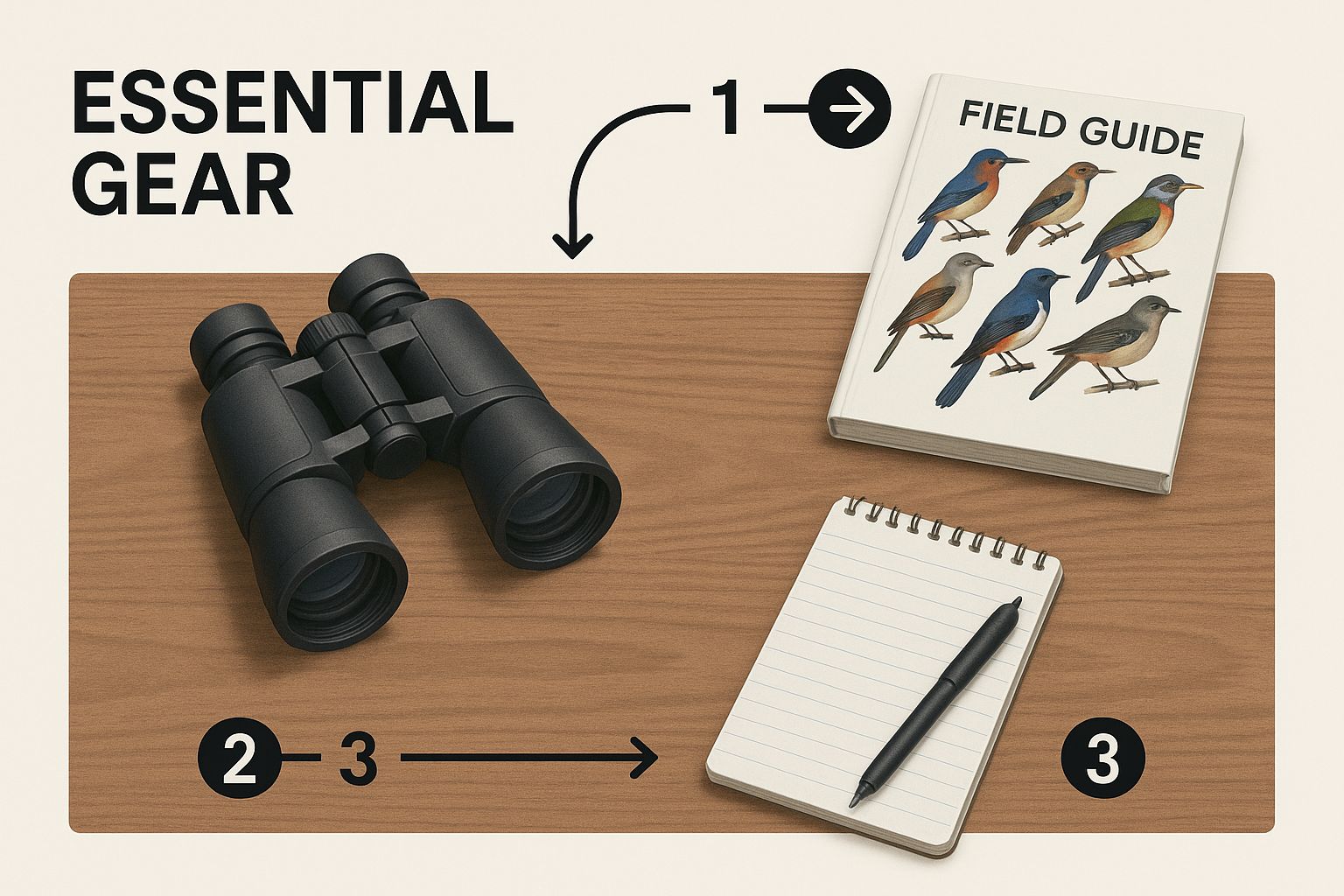
Starting with these core items helps you focus on what really matters: learning to observe, not getting bogged down by gadgets.
Decoding Your First Binoculars
Walking into a shop or browsing online for binoculars can feel overwhelming. You're hit with a dizzying array of numbers like 8x42 or 10x50. Let’s break it down simply. The first number is the magnification (how many times closer a bird appears), and the second is the objective lens diameter in millimetres (which tells you how much light they let in).
For a beginner, the sweet spot is almost always a pair of 8x42 binoculars. Why? The 8x magnification is powerful enough to see crisp details, but not so strong that the slightest hand shake makes the image jump all over the place. That stability is vital when you're trying to track a fast-moving blue tit.
The 42mm lenses gather plenty of light, giving you a bright, clear image even on a classic overcast British morning or as dusk sets in. This combination also gives you a wide field of view, meaning you see a larger slice of the scene. This makes it so much easier to find a bird in the first place and then follow its movements.
To help you see the difference, here’s a quick comparison.
Beginner's Binocular Comparison
Feature | 8x42 Binoculars (Recommended for Beginners) | 10x42 Binoculars |
|---|---|---|
Magnification | 8x (closer view) | 10x (even closer view) |
Image Stability | Easier to hold steady, less shaky | More sensitive to hand shake |
Field of View | Wider - easier to find and track birds | Narrower - can be harder to locate birds |
Brightness | Excellent, great for most light conditions | Very good, but slightly less bright than 8x42 |
Best For | All-round birding, woodland, tracking moving birds | Open spaces like estuaries, spotting distant birds |
While the extra power of 10x magnification seems tempting, the narrower view and increased shakiness can be really frustrating when you're just starting out. Stick with an 8x42 pair, and you’ll have a much more enjoyable time.
Field Guides vs Digital Apps
So, you’ve got a bird in your sights. What is it? This is where your identification resource comes in. You essentially have two choices: a traditional field guide book or a modern smartphone app. Honestly, both have their merits.
Field Guide Books:
They never run out of battery. A book is utterly reliable for a long day out.
You stay focused. With a book, there are no notifications to pull you out of the moment.
They’re brilliant for comparison. You can easily flick between pages of similar-looking species, like warblers or finches, helping you learn the key differences.
Smartphone Apps:
You can listen to bird calls. This is a massive advantage. Hearing a bird’s song can often be the final clue you need for a positive ID. Apps like the Merlin Bird ID are incredible for this.
They're always with you. Your phone is in your pocket anyway, so you have a powerful guide at your fingertips.
You can join a community. Many apps let you log your sightings and see what other people are spotting nearby.
Many experienced birders, myself included, use a mix of both. The book is perfect for studying at home, while the app is an amazing tool to have out in the field.
Other Simple Essentials
Beyond your optics and guide, a few other simple items will round out your kit without weighing you down.
I never go out without a small, weather-resistant notebook and a pen. Use it to sketch a bird’s key features, note its behaviour, or describe its call. These field notes aren't just for looking back on; the act of writing them down makes you a much more attentive observer.
Finally, dress for the part. This means comfortable, waterproof footwear and layered clothing in muted, natural colours that help you blend into the landscape. When you’re warm, dry, and comfortable, you can focus all your attention on the birds. And when you discover local wildlife in Northumberland, being properly equipped makes the experience infinitely more rewarding.
How to Find and Identify Common UK Birds
Got your binoculars ready? Good. Now for the fun part: turning those fleeting glimpses of feathers into confident identifications. This is where the real magic happens. It’s a skill that completely changes how you see the world around you, and it all starts with learning to look at birds like an expert.
It's not just about colour. We use a method often called GISS (General Impression of Size and Shape). It sounds technical, but it’s really just about taking in the whole picture—size, shape, behaviour, and sound—to quickly narrow down what you’re looking at, even in bad light or from a distance.
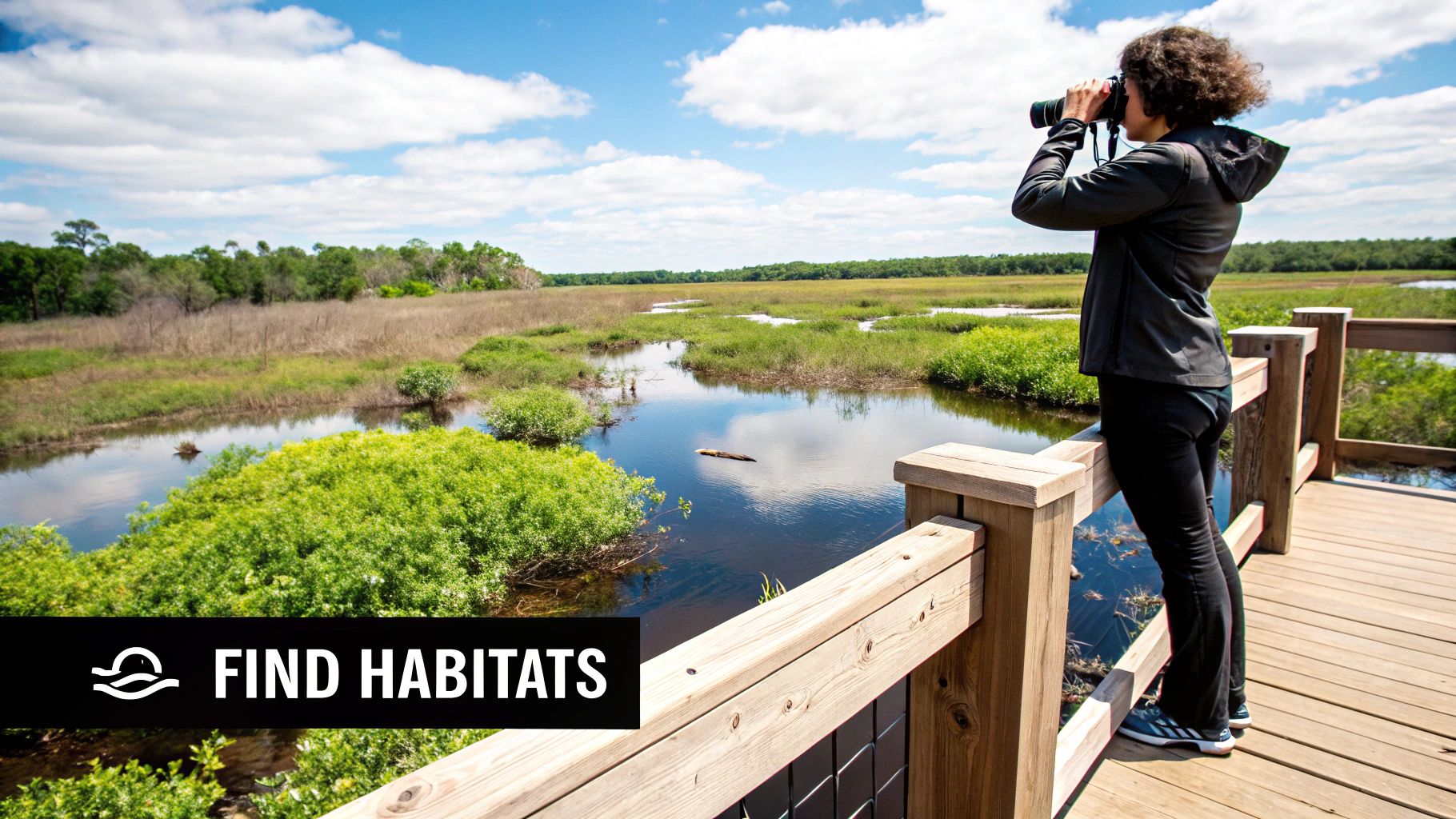
Look Beyond Colour at These Four Keys
When a new bird pops into view, try to run through this mental checklist. You don't need a perfect view; a general impression is more than enough to get you started.
Size & Shape: Is it tiny like a wren, or chunky like a woodpigeon? Is it plump and round like a robin, or sleek and streamlined like a pied wagtail? Look at the bill—a thick, sturdy bill points to a seed-eater like a finch, while a fine, pointy one is built for catching insects.
Behaviour: What's it up to? Is it boldly hopping across the lawn like a blackbird, or is it skulking in the undergrowth like a dunnock? Behaviour is a massive clue. Think of a nuthatch clinging to a tree trunk versus a long-tailed tit flitting through the treetops.
Song & Call: You'll often hear a bird long before you see it. Learning common calls is a game-changer. You don’t need to be a musical genius; just being able to tell the robin's beautiful, wistful song from the great tit’s repetitive, two-note "tea-cher, tea-cher" call will massively improve your skills.
Habitat & Location: Where are you? While some birds are happy anywhere, many stick to specific habitats. A flash of a reed warbler tells you you're near water, while the "yaffle" laugh of a green woodpecker means you’re probably near parkland or a large lawn where it can find ants.
Here’s how it works: Imagine two small brown birds on your lawn. One is hopping about confidently, pulling up worms. The other is shuffling quietly under the hedge, nervously flicking its wings. The first is almost certainly a House Sparrow. The second, with its shy nature, is a Dunnock. Their behaviour tells you everything their similar colours don't.
Where to Start Your Search
You don’t have to trek to a remote nature reserve to find birds. Incredible variety is often right under your nose.
Your Garden: A well-stocked bird feeder is the best theatre in town. It brings birds right to you, giving you fantastic, prolonged views.
Local Parks: Your nearest park, especially if it has a mix of mature trees, open grass, and a pond, is a goldmine for different species.
Waterways: Canals, rivers, and ponds attract a completely different cast of characters, from moorhens and coots to all sorts of ducks.
Timing is everything. Birds are most active first thing in the morning and again in the late afternoon as they forage for food. A quiet walk an hour or so after sunrise can be unbelievably rewarding.
Meet Your New Neighbours: The Top Garden Birds
Getting to know the common species first is the best way to build a solid foundation. A brilliant way to learn while contributing to real science is the annual RSPB Big Garden Birdwatch.
The 2025 results confirmed that the House Sparrow is still the UK's most-sighted garden bird, with over 1.2 million spotted! While the Blue Tit held onto second place, the Starling has sadly dropped to fourth, highlighting a worrying decline. The Woodpigeon and Blackbird also made the top five, showing how your own sightings help create a vital nationwide picture of our birds' health.
Here’s a quick guide to a few characters you're almost certain to meet:
Bird | Key Identification Clues |
|---|---|
Robin | Plump body, bright orange-red breast, and a bold, inquisitive nature. Sings almost all year round. |
Blue Tit | Tiny and acrobatic with a striking blue cap and yellow belly. Often seen hanging upside down on feeders. |
Blackbird | The male is glossy black with a bright orange beak and eye-ring. The female is plain dark brown. Hops across lawns. |
House Sparrow | A noisy, sociable bird. Males have a grey cap and black 'bib'; females are much plainer. Usually seen in chirpy groups. |
Great Tit | Noticeably larger than a Blue Tit, with a black head, white cheeks, and a bold black stripe down its yellow front. |
Learning these regulars will give you a huge confidence boost. Once you’ve got them down, you’ll be ready to seek out more specialised habitats. If you find yourself hooked, why not check out our guide to the [6 top spots for bird watching in Northumberland](https://www.fellfarmhideaway.com/post/6-top-spots-for-bird-watching-northumberland-2025-guide) and plan your next local adventure?
Understanding Bird Behaviour Through the Seasons
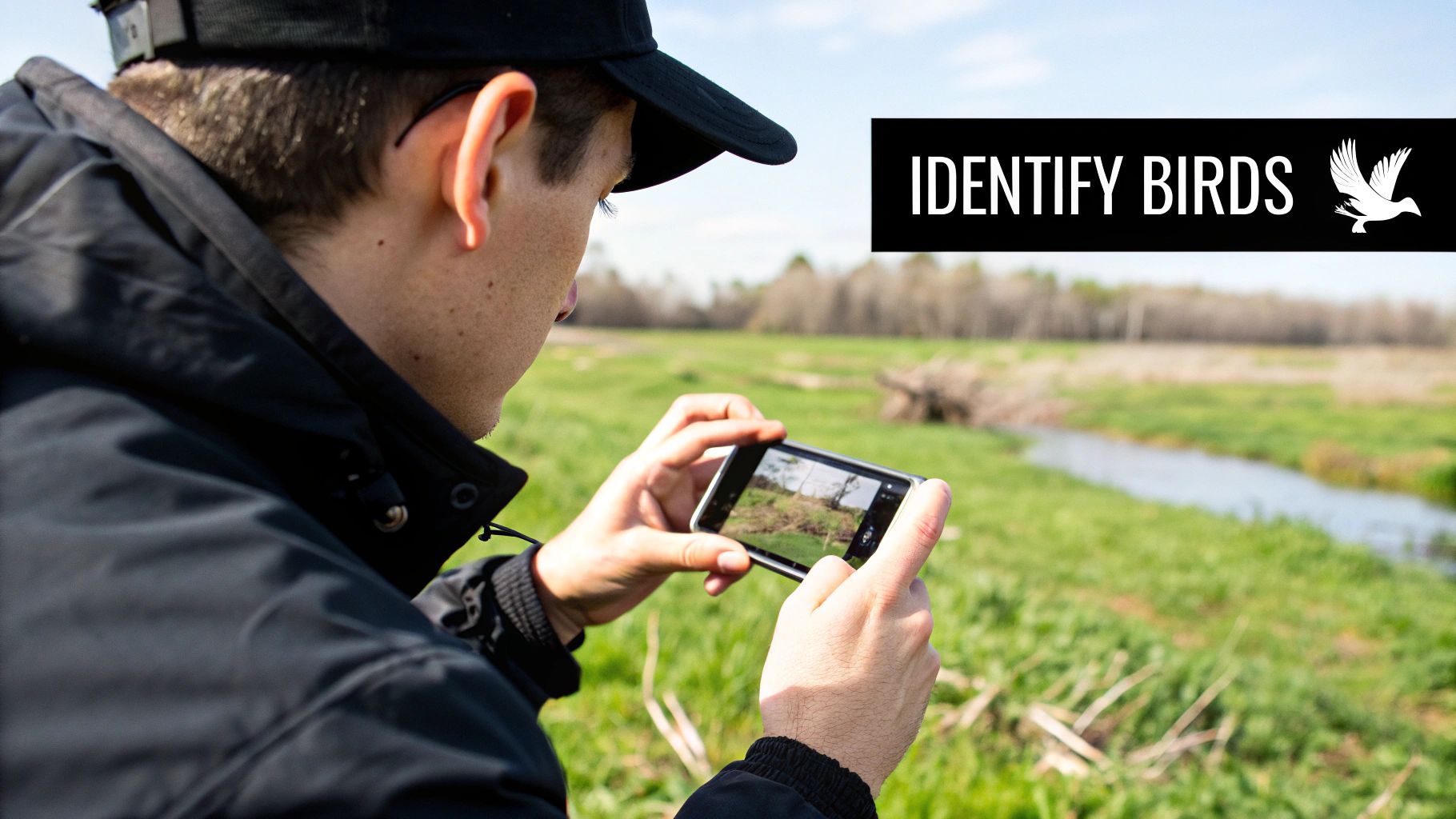
When you learn to decode their behaviour and see how their lives ebb and flow with the seasons, your observations transform. Suddenly, it’s not just a blackbird on the lawn; it’s a determined parent frantically gathering worms for its hidden chicks. This insight helps you anticipate what you might see next and connect with the real rhythm of the natural world.
The Buzz and Busyness of Spring
Spring is a season of pure, explosive energy. As the days lengthen and the air warms, nature bursts back to life, with birds leading the charge. This is the time for arrivals and establishing new life.
You’ll see migrant birds returning from their winters in warmer climes. Hearing the first chiffchaff of the year—a simple two-note song—is one of those classic signs that spring has well and truly sprung.
Listen out for the dawn chorus. It’s not just a pleasant sound; it’s a fierce declaration of territory. Males are singing their hearts out to attract a mate and warn off any rivals. You’ll also start to spot key courtship behaviours:
Courtship Feeding: You might see a male bird offering a tasty seed or insect to a female as a gift.
Aerial Displays: Keep an eye out for birds like skylarks performing incredible, acrobatic flights high in the sky.
Nest Building: Spot birds zipping past with beaks full of moss, twigs, or feathers as they get to work on their homes.
The Quieter Days of Summer
Once the nests are built and eggs are laid, summer becomes a period of intense, focused work. The dawn chorus may quieten down a little as birds shift their energy from defending territories to the demanding job of raising their young.
This is when your focus can shift to observing family life. Look for parent birds making repeated trips to the same spot—it’s a sure sign there’s a nest hidden nearby. Before you know it, you’ll see clumsy, fluffy fledglings venturing out, often begging loudly and following their parents everywhere.
By late summer, many adult birds undergo a moult, replacing their worn-out feathers after a tough breeding season. They can become quite secretive and quiet during this vulnerable time, so don’t be disheartened if your garden suddenly seems less active.
Arrivals and Abundance in Autumn
Autumn is all about transition and movement. While some of our summer visitors head south for the winter, we get an influx of new arrivals from Scandinavia and Northern Europe seeking the UK's milder weather. A classic autumn sight is watching flocks of fieldfares and redwings feasting on berries.
This is a time for feasting, as birds work hard to build up fat reserves for the colder months ahead. You’ll often see large flocks gathering to feed on fallen seeds and autumn fruits. A countryside getaway during this season can offer amazing views of these natural spectacles. If you're pondering a rural escape, you might find some inspiration by exploring the [top reasons to choose countryside holidays](https://www.fellfarmhideaway.com/post/why-choose-countryside-holidays-in-2025-top-reasons-for-all).
The Challenges and Opportunities of Winter
Winter presents the greatest challenge for birds, but it can also be one of the best times for a birdwatcher. With the branches on the trees now bare, birds are far easier to spot. Your garden bird feeder becomes a vital lifeline and a brilliant stage for observation.
The weather plays a huge role in their behaviour. A cold snap makes finding food incredibly difficult for smaller birds like wrens and long-tailed tits. This is why watching the garden during January’s mix of cold and mild spells can be so fascinating—you never know who might show up. Your observations contribute to a bigger picture, too. You can [learn more about how the Big Garden Birdwatch tracks these trends](https://www.rarebirdalert.co.uk/v2/Content/Make_It_Count_RSPB_Big_Garden_Birdwatch_2025.aspx) and see the real impact of citizen science.
Practicing Ethical Bird Watching and Conservation
As you get drawn deeper into the world of bird watching, you’ll naturally find yourself wanting to protect the very creatures that bring you so much joy. Becoming an ethical birder is one of the most important parts of the journey. At its heart, it’s simple: the birds' welfare always comes first.
We are visitors in their world, and it’s our job to make sure our presence doesn’t cause them any harm or stress. This mindset shifts your hobby from just watching into something more like active stewardship. Every choice matters, from how close you get to what you share online.
Give Them Space
The golden rule of bird watching is to keep a respectful distance. If a bird changes its behaviour because of you—if it stops singing, looks alarmed, or flies off—you’re too close. This is absolutely critical near nests or when you spot birds with their young.
Chasing that perfect photo is never worth stressing a parent bird, which could even lead it to abandon its nest. This is what binoculars and zoom lenses are for! They let you get that brilliant close-up view without ever intruding. A stressed bird isn't a happy bird, and you won’t be observing its natural, fascinating behaviour anyway.
A good rule of thumb is to stay far enough away that the bird continues its natural activities, completely unbothered by you. Real joy comes from watching undisturbed life unfold, not from forcing an interaction.
The Problem with Playback
It can be tempting to use an app that plays bird calls to lure a shy species out into the open. It seems harmless, but this practice can be incredibly disruptive for the birds.
When a territorial bird hears what it thinks is a rival's song, it can cause immense stress. It pulls the bird away from essential activities like finding food, preening its feathers, or caring for its young. Imagine someone ringing your doorbell over and over just to watch you answer. It’s confusing and draining. It’s far more rewarding to patiently learn the calls yourself and wait for a natural sighting.
Leave No Trace and Protect Habitats
Your actions on the ground are just as important. Always stick to marked paths and trails whenever possible. Wandering off-track can damage the fragile plants that birds and other wildlife rely on for food and shelter. You could even stumble upon a well-hidden ground nest by mistake.
This principle of minimal impact is a cornerstone of being responsible outdoors. It helps preserve these beautiful spaces for both the wildlife and for future generations of visitors to enjoy. Local efforts in [family farm conservation and sustainable escapes](https://www.fellfarmhideaway.com/post/family-farm-conservation-sustainable-escapes-in-northumberland-2025) are a perfect example of how vital it is to protect habitats to help local ecosystems thrive.
Be Mindful of What You Share
In the age of social media, sharing the exact location of a rare, sensitive, or nesting bird can have terrible consequences. Even with the best intentions, broadcasting a precise location can lead to crowds flocking to the area. This puts huge stress on the bird and can damage its habitat. Sadly, it can also alert poachers and illegal egg collectors.
If you’re lucky enough to find a rare bird, savour the moment. Then, report your sighting privately to a local county bird recorder or through a trusted platform like BirdTrack. This way, your find contributes to valuable scientific data without putting the bird in harm’s way.
Your passion for birds can be a powerful force for good. By being a thoughtful and ethical observer, you ensure your hobby helps rather than harms, making every single sighting that much more special.
Common Questions from New Bird Watchers
Diving into any new hobby brings up a flurry of questions. Birdwatching is no different. It’s completely natural to wonder if you’re doing things right or if you have the correct gear. We’ve put together this section to tackle the queries we hear most often from newcomers, giving you clear, straightforward answers to get you started with confidence.
Think of this as your go-to guide. Whenever a little uncertainty creeps in, you’ll find the practical advice you need to get back on track and start enjoying the birds.
Do I Need an Expensive Camera to Start?
Not at all. This is probably the biggest myth in the world of birdwatching. It's crucial to remember that birdwatching and bird photography are two distinct hobbies. They often overlap, of course, but their main goals are different.
As a beginner, your real mission is to learn how to observe and identify birds. Your most powerful tool for this isn’t a camera, but a good pair of binoculars that bring the birds closer without disturbing them. A camera can be a fun accessory later on, but it’s far from a necessity at the start.
Your smartphone can be surprisingly useful, too. Snapping a quick, even blurry, photo is a great way to capture a few key features. It acts as a memory aid for when you’re back home with your field guide, trying to figure out what you saw. So, focus your initial budget and energy on good optics, not a fancy camera. Patience and a keen eye are the real keys.
What Is the Best Single Resource for UK Beginners?
For anyone starting out in the UK, the Royal Society for the Protection of Birds (RSPB) is an absolutely essential first stop. Their website is a treasure trove of information that feels like it was made just for beginners.
You'll find some fantastic tools there, including:
An Online Bird Identifier: This interactive tool is brilliant. It helps you narrow down sightings based on a bird's colour, size, and where you saw it.
Detailed Species Guides: Learn about the habits, songs, and key features of hundreds of UK birds.
Maps of Local Reserves: Find RSPB-managed nature reserves near you. These are perfect, welcoming places for a day out.
Joining the RSPB not only gets you brilliant resources and their quarterly magazine, but your membership directly supports vital conservation work across the country. For a physical book, the 'RSPB Handbook of British Birds' is widely considered the gold standard field guide for newcomers.
How Do I Find Local Birding Groups?
Joining a local group is one of the best things you can do to speed up your learning and share your new passion. There’s nothing quite like learning from experienced birders who know all the best local patches.
A great place to start is the RSPB's website, as they keep a comprehensive directory of local groups all over the UK. You can also find information on the websites of your regional Wildlife Trusts. And don't forget to check the old-school spots, like community notice boards in libraries, village halls, or local shops.
Attending a guided walk at a nature reserve is another brilliant option. These are usually very informal, friendly events designed for all skill levels. It's a fantastic, low-pressure way to meet other enthusiasts and get tips specific to your area. Many find that sharing the experience enhances the joy of the hobby, especially during a quiet weekend away. It's why combining a love for nature with a peaceful break is so popular, with many people looking for the [top romantic getaways in Northumberland](https://www.fellfarmhideaway.com/post/top-6-romantic-getaways-northumberland-for-2025-book-now) to create those memorable sightings.
Can I Go Birdwatching If I Live in a City?
Absolutely! Urban birding is not only possible but also incredibly rewarding. Cities and towns offer a surprising mosaic of habitats that support a rich variety of birdlife. You just need to know where to look.
City parks, canals, railway embankments, and even cemeteries can be genuine hotspots. You might be amazed to find a flock of colourful goldfinches feeding on thistle seeds on a patch of scrubland, or a song thrush belting out its tune from a TV aerial.
Some of the most dramatic urban birding involves species that have adapted specifically to our built environments. Peregrine falcons, the fastest animals on the planet, often nest on tall buildings, which act as modern-day cliff faces. In winter, you might even spot beautiful waxwings feasting on berry trees in a supermarket car park. Urban birding proves you don't need to travel for miles to connect with nature; sometimes, you just need to look up.
At Fell Farm Hideaway, we believe that connecting with nature is the ultimate escape. Our cosy cabins offer the perfect base for exploring the rich birdlife and stunning landscapes of Northumberland, allowing you to practice your new hobby in a place of peace and beauty. Book your serene getaway today.
Comments